The Cost of Covering
Hidden in Plain Sight: The Blood
Modern Christianity has largely scrubbed blood from its vocabulary.
The old hymns knew what to do with it. They sang about being washed in it, covered by it, cleansed through it. But somewhere along the way the imagery began to feel uncomfortable, too visceral, too strange for a culture that prefers its spirituality clean and its worship accessible. Many churches today can go weeks without the word being spoken at all.
Scripture does not share that discomfort.
From the first animal death in Genesis 3 to the Lamb standing at the center of the throne in Revelation 5, blood runs through the entire biblical story as one of its most consistent and theologically freighted threads. It is not incidental imagery. It is not primitive symbolism waiting to be replaced by something more refined. It is the load-bearing structure of the entire redemptive story, present at the beginning, present at the end and present at every major turning point in between.
It has been hiding in plain sight across the whole of Scripture, waiting for anyone willing to follow it from beginning to end.
Life Is in the Blood
Before tracing the thread, we need to understand why blood carries the weight it does in Scripture.
God provides the answer directly in Leviticus 17:11: “For the life of a creature is in the blood, and I have given it to you to make atonement for yourselves on the altar; it is the blood that makes atonement for one’s life.” The Hebrew word translated “life” here is nephesh, a word that means life, soul or living being. Blood is not merely a biological fluid in the biblical imagination. It is the bearer of life itself. Where blood is, life is. Where blood is shed, life is given.
This is why God prohibits the consumption of blood as far back as the Noahic covenant and reiterates the prohibition throughout the Mosaic law. Blood is not food. It is not a resource to be consumed. It belongs to God because life belongs to God. To drink blood would be to treat the bearer of life as ordinary, to consume what God alone has the right to receive.
Everything about blood rests on this foundation. Sacrifice works because life is in the blood. Atonement is possible because the life given in the blood covers the life forfeited in sin. The logic is not primitive or arbitrary. It is grounded in a theology of life that runs from creation to new creation.
The First Death
The blood thread begins before anyone has named it.
In Genesis 3, after the fall, Adam and Eve cover themselves with fig leaves. It is the first human religious act, self-made, self-directed, a solution assembled from what they could reach with their own hands. God sets it aside. He makes them garments of skin, the Hebrew kuttonet or, tunics of animal hide. Skin requires an animal. An animal must die.
In a world where death has just entered as a consequence of sin, the first death recorded in Scripture is not human. It is an animal, provided by God Himself, to cover the shame of the people He had made. The covering that works is not the one humanity fashioned. It is the one God provided, and it cost a life.
Most readers move through this moment without pausing. But it is the first acted-out picture of substitutionary sacrifice in all of Scripture. An innocent life given so that human shame could be covered. God providing what humanity could not provide for itself. The pattern that will run through the entire Bible is established here, quietly, before the exile even begins.
Blood That Speaks
The next major moment in the blood thread is Abel’s offering, and it contains two observations that most readers miss entirely.
Abel brought fat portions from the firstborn of his flock. The firstborn and the fat portions were the best and the costliest of what he had. Something died so that offering could be made. The offering that found favor before God was the one that required a death, echoing the pattern already established in Eden. Genesis does not state explicitly that blood was the sole reason God preferred Abel’s offering, and Hebrews 11:4 points to faith as the distinguishing factor. But the offering that found favor was the one that cost a life, and that is not incidental.
Then Cain kills his brother. And what God says next is one of the most profound and unsettling statements in all of Scripture.
“Your brother’s blood cries out to me from the ground.” (Genesis 4:10)
God hears blood. Abel is dead and buried and gone from human sight, but his blood is still speaking and God is still listening. The life that was in that blood has not become invisible to its Maker. Human blood, bearing human life made in the image of God, has a relationship to God that death does not sever. He does not lose track of it. He hears it.
The New Testament picks up this thread and does something extraordinary with it. Hebrews 12:24 tells us that Jesus’ blood speaks a better word than the blood of Abel. Abel’s blood cried out from the ground and it was heard. Christ’s blood speaks forgiveness rather than accusation, restoration rather than judgment, life rather than death. But notice what that comparison assumes: Abel’s blood was already speaking. It was already being heard. The voice of shed blood before God is not a metaphor. It is a reality that Scripture treats with complete seriousness from the very first murder forward.
Noah and the Covenant of Blood
After the flood, the first thing Noah does when he sets foot on dry ground is build an altar and offer burnt offerings to God. The sacrifice comes before anything else, before planting, before building, before establishing any of the structures of the new world. The instinct to bring blood before God in gratitude and acknowledgment is the first act of the post-flood humanity.
God’s response is the Noahic covenant, and within it He establishes something new. For the first time, human beings are explicitly permitted to eat animals. “Everything that lives and moves about will be food for you. Just as I gave you the green plants, I now give you everything” (Genesis 9:3). But the permission comes with a boundary that reiterates the theology of Leviticus 17: “But you must not eat meat that has its lifeblood still in it” (Genesis 9:4).
You may eat the animal. You may not consume the blood. The life belongs to God.
God then extends the principle. He requires an accounting for human blood as well: “Whoever sheds human blood, by humans shall their blood be shed; for in the image of God has God made mankind” (Genesis 9:6). Human life is not simply valuable. It is sacred in a specific way, because human beings bear the image of God. To shed human blood without cause is to attack something that belongs to God in a way that animal life, though also sacred, does not. The blood theology that began with the garments of skin in Eden is becoming more explicit with every generation.
Blood Across Every Culture
Here is a fact that deserves more attention than it usually receives.
Blood sacrifice is not unique to Scripture. It appears in virtually every religious tradition that has ever existed, in every corner of the world, across every era of recorded human history. The ancient Mesopotamians offered blood sacrifice to their gods. So did the Egyptians, the Greeks, the Romans, the Aztecs, the Celts and the cultures of sub-Saharan Africa. It exists today in various forms of folk religion, in syncretic traditions across Latin America, Africa and Asia, and in occult practice that has never disappeared.
This universality is not coincidence. It points to something embedded in human consciousness, a deep intuition that connection to the divine, to power, to the spiritual realm, requires that something be given, that something must die. That intuition was placed there by God. What happened to it across the nations and across history is one of the great distortions of the fall.
The critical distinction is what the sacrifice is for and to whom it is directed.
Throughout the biblical story, the theology of sacrifice centers on a moral reality. Sin creates a breach between humanity and a holy God. That breach requires covering. The sacrifice moves toward God as an acknowledgment of guilt and a plea for restoration. The worshiper is not trying to gain something new. They are trying to be restored to something lost.
In polytheistic and occult traditions the logic is almost entirely reversed. The gods are not necessarily holy and the worshiper is not necessarily guilty. The sacrifice is a transaction. Blood is currency. You offer something of value to obtain something of value in return, power, protection, favor, victory, access to spiritual forces that would otherwise be unavailable to you. There is no concept of sin requiring covering. There is only a ledger to be balanced, a power to be tapped, a deity to be persuaded.
Outside of Christ there is no connection to the divine without cost. Every system, ancient and modern, operates on the assumption that the worshiper must provide something, must bring the blood, must pay the price of access. The instinct is not wrong. The direction is. What actually stands behind those sacrifices, who or what receives the worship that was always meant for God alone, is a question the series will return to in a later article. For now it is enough to notice that the instinct itself, the deep human certainty that blood matters and that access to the divine requires a cost, was placed there by God and points back toward Him.
The Passover and the Pattern Complete
When God delivers Israel from Egypt, He does not simply overpower Pharaoh. He structures the deliverance around blood.
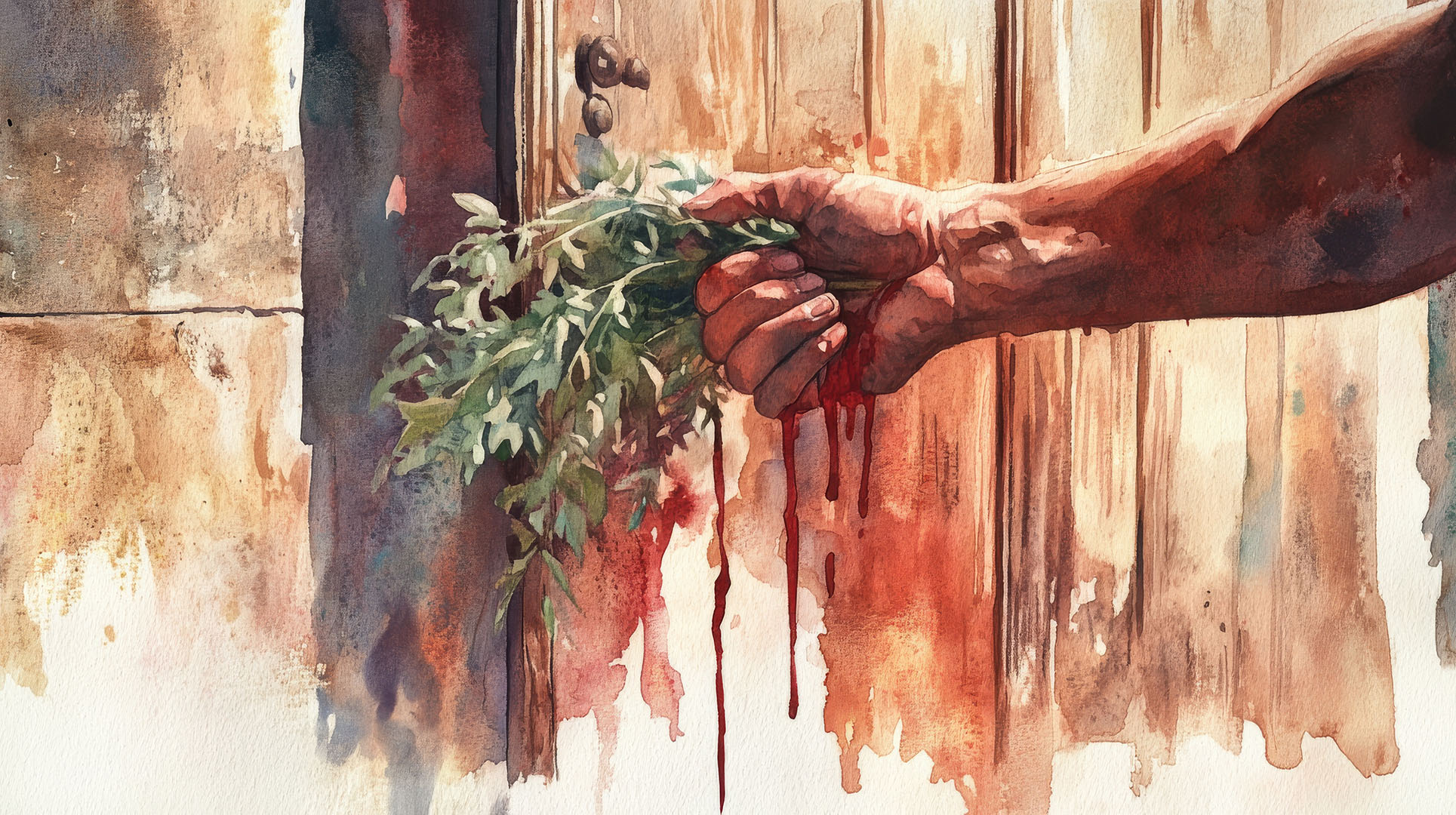
A lamb without defect is selected, killed at twilight, and its blood painted on the doorposts and lintel of each Israelite home. When the destroyer passes through, he passes over every home marked with blood. The covering is not moral achievement. It is not Israel’s faithfulness or goodness or religious effort. It is blood on the door, provided at God’s instruction, applied in obedience and received by faith.
The entire sacrificial system that follows in the Mosaic law extends and formalizes this logic. The Day of Atonement, described in Leviticus 16, is its highest expression. The high priest enters the Most Holy Place once a year, not without blood, carrying the blood of a bull and a goat to make atonement for himself and for the people. The access that the presence of God requires cannot be approached without the covering that blood provides.
Hebrews 9:22 draws the principle explicitly: “Without the shedding of blood there is no forgiveness.” This is not a New Testament innovation. It is the logic that has been running since Eden, formalized in the law, enacted year after year in the temple, pointing forward to a sacrifice that the blood of bulls and goats could never ultimately provide but could only anticipate.
The animals on Israel’s altars were not the point. They were the shadow of the point. The entire system was designed by God to make one thing clear: the breach sin creates requires a life to cover it, and the life God would ultimately provide would be His own.
The Great Inversion
Every religious system in human history, outside of the gospel of Jesus Christ, operates on the same foundational assumption. The worshiper must bring the sacrifice. The worshiper must provide the blood. The worshiper must pay the cost of access to the divine.
The gospel overturns this entirely.
John the Baptist sees Jesus approaching the Jordan and says: “Look, the Lamb of God, who takes away the sin of the world” (John 1:29). Not a lamb provided by the worshiper. The Lamb provided by God. The one to whom all the other lambs had been pointing. The one whose blood would accomplish what no animal blood could accomplish, not covering sin temporarily but taking it away permanently.
At the cross, the logic of every sacrifice ever offered reaches its fulfillment and its end. The breach sin created required a life. God provided the life. The covering humanity could not produce for itself, God produced at the cost of His own Son. The fig leaves of human religious effort are set aside once more, as they were in Eden, and replaced with a covering that cost everything and was given freely.
The writer of Hebrews draws the contrast with care. The old covenant priests stood daily offering sacrifices that could never finally take away sin. Jesus offered one sacrifice for sin for all time and sat down at the right hand of God. The standing never stopped in the temple because the work was never finished. The sitting is the signal that the work is done.
“It is finished.” Three words spoken from the cross that echo across every altar, every sacrifice and every drop of blood offered to every deity in every culture since the fall. It is finished. The price has been paid. The covering has been provided. The Lamb has been slain.
From the Throne to the Tree
The blood thread does not end at the cross. Revelation carries it forward in two directions simultaneously, and both directions matter.
In Revelation 5, the apostle John weeps because no one is found worthy to open the scroll that contains the completion of history. Then one of the elders speaks: “Do not weep! See, the Lion of the tribe of Judah, the Root of David, has triumphed.” John turns to see the Lion and finds instead a Lamb, looking as if it had been slain, standing at the center of the throne. The Lamb who was sacrificed is the one who holds history in His hands. The mark of the sacrifice is not erased in glory. It is the basis of His worthiness.
The saints in Revelation 12:11 overcome the accuser “by the blood of the Lamb and by the word of their testimony.” The blood that covered sin in Eden, that called out from the ground after Abel, that marked the doorposts in Egypt, that was sprinkled on the mercy seat year after year, is still the ground of victory at the end of history.
But Revelation does not present only one side of the blood thread. The same substance that covers the believer marks the judgment of those who rejected the covering. The waters of the earth turn to blood in the trumpet and bowl judgments, echoing the first plague in Egypt and carrying the same weight: a holy God responding to a people who refused what He provided. The rider on the white horse in Revelation 19 appears with a robe dipped in blood before the battle even begins. And Revelation 14:20 contains one of the most sobering images in all of Scripture: the winepress of God’s wrath produces blood rising as high as a horse’s bridle for a distance of 1600 stadia. The image is not presented for shock. It is presented for weight. The God who takes blood seriously as the bearer of life takes equally seriously what it means to reject the life He offered.
The blood of the martyrs cries out from under the altar in Revelation 6, just as Abel’s blood cried out from the ground. God heard it then. He hears it still. And Revelation is the account of what it looks like when He finally answers every cry at once.
This is not a contradiction of the mercy that runs through the blood thread. It is its completion. Justice and mercy have always stood together in this story, from the garments of skin in Eden to the cross of Calvary. Revelation simply shows what it looks like when both are finally, fully and permanently resolved.
And then the final vision. The tree of life reappears in Revelation 22, the same tree that was guarded after the exile from Eden. The river of life flows from the throne of the Lamb. The nations are healed. What was lost in the garden is restored. Access to the tree of life, closed after the fall so that humanity would not live forever in their sin, is opened again, this time rightly, in a redeemed creation where sin has been finally and fully dealt with.
The thread that began with an unnamed animal in a garden ends with a Lamb on a throne and a tree beside a river, and the nations coming freely to drink.
The God Who Provides
What does the blood thread reveal about God?
It reveals a God who takes sin with absolute seriousness. The breach it creates is real. The cost of covering it is real. God does not wave sin away or treat the moral order of His creation as negotiable. Every sacrifice, from the garments of skin in Eden to the cross of Calvary, is a declaration that sin has consequences and that those consequences cannot be ignored.
But it also reveals a God who provides what He requires. He does not stand at a distance demanding payment and waiting to see if humanity can produce it. He enters the story. He designs the system. He provides the lamb when Abraham’s knife is raised. He specifies the Passover lamb when Israel needs covering. And finally, He sends His own Son.
Every other religious system says bring your blood. The gospel says the blood has been brought for you. Every other system says pay the cost of access. The gospel says the cost has been paid. Every other system leaves the worshiper standing, the work never finished, the debt never fully settled. The gospel says it is finished, sit down, the Lamb has done what no worshiper could ever do.
This is the great hidden-in-plain-sight reality of the blood thread. It was never about the animals. It was never about the ritual. From the very first garment of skin sewn by God in a garden, it was about the lengths to which a holy and loving God would go to bring His people back to Himself.
God is not merely revealing information. He is revealing Himself.
The story of blood does not end at the cross. It ends at the throne. The Lamb who was slain now reigns. The sacrifice that covered sin became the King who rules forever. The One who gave His life now holds history in His hands. From Eden to Calvary to the throne room of heaven, the blood thread has always been revealing the same God: holy enough to judge sin, loving enough to bear its cost Himself.
“Worthy is the Lamb, who was slain, to receive power and wealth and wisdom and strength and honor and glory and praise!” (Revelation 5:12)
The more carefully we read Scripture, the more we discover that the blood thread has been running beneath the surface of the whole story, hiding in plain sight from the first pages of Genesis to the last pages of Revelation. It was always pointing to the same place. It was always pointing to the Lamb.