Those Are In the Bible?
Hidden in Plain Sight: Behemoth, Leviathan and the Creatures We Cannot Explain
Human beings have always been fascinated by mysterious creatures.
Ancient civilizations told stories about dragons, sea monsters and giants. Today those stories have simply taken new forms. Dinosaurs fill museums. Cryptids fill documentaries. Bigfoot, the Loch Ness Monster and undiscovered creatures of the deep continue to capture the imagination of people who would never describe themselves as superstitious. The names change across the centuries. The fascination does not.
Many readers are surprised to discover that the Bible contains its own collection of extraordinary creatures. Behemoth. Leviathan. Dragons. Giants. Winged serpents. Creatures surrounding God’s throne unlike anything popular imagination has prepared us to encounter. Some appear only once. Others reappear throughout Scripture in different contexts. Some seem entirely physical. Others become symbols that help explain realities beyond human understanding. Some belong to the earthly realm. Others belong to a heavenly one that looks nothing like the imagery of greeting cards and Christmas ornaments.
The obvious question is whether these creatures really existed. But perhaps that is not the most important question. Perhaps the better question is this: why did God include them in Scripture? As this series has repeatedly demonstrated, the Bible often contains things that remain hidden until we slow down enough to notice them. These creatures have been hiding in plain sight across the full length of Scripture, waiting for anyone willing to look carefully at what is actually there.
Behemoth: The Beast of the Earth
Behemoth appears in only one place in Scripture and that fact alone should capture our attention. God introduces it in Job 40, at the very end of a book filled with suffering and questions, and the context matters enormously.
Job has lost his children, his health, his wealth and his reputation. After dozens of chapters of arguments and appeals for answers, God finally speaks. But God does not explain Job’s suffering. He does not explain Satan’s role in what happened. He does not provide the theological framework Job has been demanding. Instead He begins speaking about creation: the stars, the weather, the seas, the animals. And then He says: “Look at Behemoth, which I made along with you.” (Job 40:15)
Look at it. God does not identify it. He does not classify it. He simply points toward it and then describes it in detail that has puzzled readers for centuries. Its strength is in its hips and its power in the muscles of its belly. Its tail moves like a cedar tree. Its bones are like tubes of bronze and its limbs like rods of iron. It lies under lotus plants among the reeds in the marsh, hidden by shade, concealed among the willows. And then the most striking line: “It ranks first among the works of God.” (Job 40:19)
For centuries readers have debated what Behemoth is. Some have suggested a hippopotamus. Others an elephant. The cedar-like tail has led many to wonder whether the description points toward a creature no longer living, which has fueled ongoing fascination with the connections between Scripture and what paleontology has uncovered. Scripture never answers the question and perhaps that is intentional, because the point of the passage does not appear to be identification. The point is wonder. Job wants answers. God points to a creature Job cannot explain or control. The lesson is not zoology. It is humility. If Job cannot fully understand the creatures God made, how can he expect to fully understand everything God is doing?
Leviathan: The Beast of the Sea
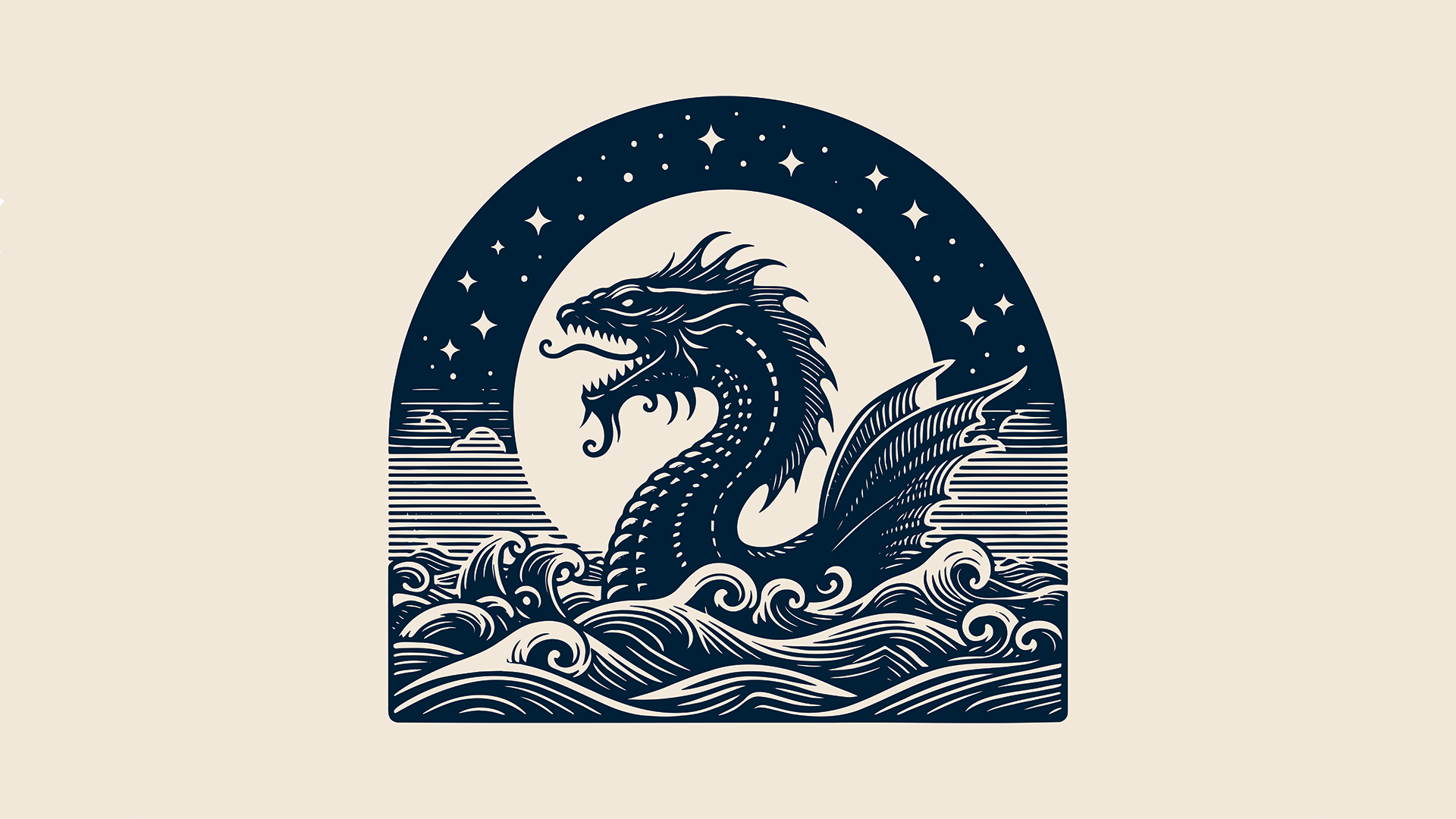
If Behemoth is mysterious, Leviathan is more so. Unlike Behemoth, Leviathan appears throughout Scripture in multiple contexts and its meaning seems to expand with each appearance.
In Job 41 God continues His answer to Job with an extended and extraordinary description of Leviathan. Who can open its jaws? Who can pierce its hide? Its sneezes flash forth light. Its eyes are like the rays of the dawn. Flames pour from its mouth. Smoke from its nostrils. Its breath sets coals ablaze. It makes the deep churn like a boiling pot. There is nothing like it on earth. It is made without fear. It looks down on all that is haughty and is king over all that are proud. Job 3:8 refers to those skilled at rousing Leviathan, suggesting that in the ancient world Leviathan was associated with something that could be summoned or awakened, adding a dimension that goes beyond any ordinary sea creature.
Psalm 74:13-14 describes God crushing the heads of Leviathan, giving it as food to the creatures of the desert, in a passage recalling God’s power over the waters at the exodus. Psalm 104:25-26 describes Leviathan playing in the sea that God created, a creature at home in the vast and teeming ocean, apparently at play in the very waters that terrified ancient sailors. Then Isaiah 27:1 moves into fully symbolic territory: “The Lord will punish Leviathan the gliding serpent, Leviathan the coiling serpent. He will slay the monster of the sea.” A serpent. A sea creature. A symbol of cosmic opposition to God’s purposes. The same creature that is at play in Psalm 104 becomes in Isaiah a figure of eschatological judgment.
Readers have offered many explanations. A crocodile. A whale. An extinct marine reptile. A symbolic representation of ancient chaos mythology. None of them accounts for every biblical reference because Leviathan is doing more than one thing across those references. In Job it is an untamable creature that points to the limits of human understanding. In the Psalms it is subject to God’s sovereign authority. In Isaiah it is a symbolic figure whose defeat points toward the final victory of God over every power that opposes Him. Through every appearance one truth remains unchanged. God rules over it. Leviathan is not His rival. It is His creation, and whatever it ultimately represents, it bows before the One who made it.
The Sea, Chaos and the Things We Cannot Control
Throughout Scripture the sea carries a consistent theological weight. It represents the unknown, the threatening, the uncontrollable. Floodwaters bring judgment. Storms threaten destruction. The depths conceal what human beings cannot see. Even today, the majority of the ocean floor remains unexplored. We know more about the surface of the moon than we do about the deepest parts of the sea.
Ancient cultures often described cosmic battles between competing divine powers, with the sea and its monsters as the chaos that the gods struggled to subdue. Scripture tells a fundamentally different story. In Genesis 1, God does not battle the deep. He speaks over it and divides it. In Psalm 104, God forms Leviathan to play in the sea He made. In Job, God asks whether any human being can subdue Leviathan while implying that He himself has no such limitation. The sea and its creatures are not threats to the God of Scripture. They are His creation, subject to His word, participants in the world He governs.
That distinction matters because it shapes how believers are meant to relate to the unknown. The things we cannot explain, the creatures at the edges of our understanding, the depths we cannot plumb, do not represent a gap in God’s sovereignty. They represent the inexhaustible richness of a creation made by a God whose creativity and power exceed anything we can fully catalog. Leviathan playing in the sea is not a picture of uncontrolled chaos. It is a picture of a God so sovereign that even the most terrifying creature in the ancient imagination exists to demonstrate His glory.
Dragons, Serpents and the Fiery Flying Creature
Scripture contains a category of creature that most modern translations handle with significant variation because the Hebrew words involved resist clean equivalents in English.
The word tannin appears across multiple contexts. In Genesis 1:21 it describes the great sea creatures God made on the fifth day, which some translations render as sea monsters. In Exodus 7:9-12 Aaron’s staff becomes a tannin before Pharaoh, which most translations render as snake or serpent. In Isaiah 51:9 God is described as cutting Rahab to pieces and piercing the tannin, in the context of the exodus from Egypt. In Ezekiel 29:3 and 32:2 the word describes Pharaoh himself as a great tannin lying in the Nile. The same Hebrew word moves from a physical creature in the sea to a transformed staff to a symbolic figure for Egypt’s king. The range itself is theologically instructive. The creature of chaos and the instrument of judgment and the symbol of earthly power all share a word.
Isaiah 14:29 and 30:6 contain a description that stops careful readers: the fiery flying serpent, in Hebrew the saraph meopheph. The word saraph, connected to burning, is the same root as the word translated seraphim in Isaiah 6. The connection between serpentine imagery, fire and the divine realm is a thread the series has been tracing since the serpent in the garden. Whether the fiery flying serpent describes a physical creature of the ancient Near Eastern wilderness or something more, the description itself carries the same weight as so many of the creatures in this article: it exceeds our categories and resists easy classification.
Deuteronomy 32:33 describes the poison of serpents as the wine of the wicked, using tannin in a poetic context. Psalm 91:13 promises that the one who dwells in the shelter of the Most High will tread on the lion and the cobra and trample the great lion and the serpent, with tannin appearing alongside lion and cobra as a creature of threat overcome by divine protection. These creatures are not simply zoological references. They carry theological weight throughout the canon.
The Giants
The Nephilim article in this series explored the origins of the giant peoples in Genesis 6 and the careful distinctions Scripture makes between the different groups. But the giant peoples who appear in the conquest narratives deserve a brief treatment here because they represent one of the most consistently surprising features of the Old Testament for modern readers.
The Rephaim appear first in Genesis 14:5, identified as a people defeated by the four kings. Deuteronomy 2:10-11 describes the Emim, a great and numerous people as tall as the Anakim, as Rephaim, and notes that the Moabites called them Emim. The Zamzummim of Deuteronomy 2:20 are identified the same way, a great and numerous and tall people, also Rephaim, defeated by the Ammonites. The Anakim themselves appear in Numbers 13:22 and Joshua 11:21-22 as a race connected to the giants of the land, whose presence caused the twelve spies to feel like grasshoppers.
Og, king of Bashan, receives a specific detail that Scripture apparently considered worth preserving. Deuteronomy 3:11 records that his bed was made of iron and was nine cubits long and four cubits wide, approximately thirteen feet by six feet. The detail is not incidental. It is preserved as evidence of something that future generations might otherwise find difficult to believe. Scripture treats Og’s size as a historical fact worth documenting precisely.
These peoples do not receive extensive theological development in the text. Scripture records their existence, notes their extraordinary size and traces their defeat by Israel or by earlier peoples, often with the explicit note that God drove them out or gave Israel victory over them. The giant peoples are not figures of spiritual power in Scripture the way Leviathan is. They are physical peoples whose unusual characteristics point toward the broader disruption of creation that the Nephilim article explored. They belong in this article because they are among the things Scripture describes that modern readers often find themselves wholly unprepared to encounter.
Creatures Before the Throne
If the physical creatures of Scripture have been surprising, the heavenly creatures are almost entirely unlike what popular imagination has prepared readers to find.
Cherubim appear first in Genesis 3:24 as the guardians God places at the entrance to Eden after the exile, armed with a flaming sword that turned every direction. This is not the round-cheeked, winged infant of Renaissance painting. These are formidable beings entrusted with guarding the most sacred threshold in creation. In Exodus 25:18-22 God instructs that two golden cherubim be placed on the cover of the Ark of the Covenant, their wings spread upward and their faces toward each other, with God meeting His people from above the space between them. They are not decorative. They mark the presence of the holy.
Ezekiel 10 describes the cherubim in detail that resists easy visualization. Each has four faces: the face of a cherub, the face of a human being, the face of a lion and the face of an eagle. Each has four wings. Their entire bodies, including their backs and their hands and their wings, are full of eyes all around. Beside each cherub is a wheel, and the wheels are described as wheel within wheel. The spirit of the living creatures is in the wheels. When the creatures move the wheels move with them. When the creatures stand still the wheels stand still. Ezekiel is not being vague. He is describing something that genuinely exceeds the categories available to him.
The seraphim of Isaiah 6 appear in a single passage and it is one of the most astonishing in all of Scripture. Isaiah sees the Lord seated on a throne, high and exalted, with the train of His robe filling the temple. Above Him stood the seraphim. Each had six wings: with two they covered their faces, with two they covered their feet, and with two they flew. And they called to one another: “Holy, holy, holy is the Lord Almighty; the whole earth is full of his glory.” (Isaiah 6:3) Their name is connected to burning. They cover their faces in the presence of the One they attend. They cover their feet in an act of reverence. And they declare without ceasing the holiness of the God they serve.
The living creatures of Revelation 4 appear around the throne of God and share characteristics with both the seraphim and the cherubim. The first is like a lion. The second like an ox. The third has a face like a human. The fourth is like a flying eagle. Each has six wings and is covered with eyes all around and within. Day and night they never stop saying: “Holy, holy, holy is the Lord God Almighty, who was, and is, and is to come.” (Revelation 4:8) John is seeing from a different angle than Isaiah but the central figure, a God of absolute holiness attended by extraordinary beings declaring that holiness without ceasing, is the same.
These heavenly creatures have nothing to do with the popular image of angels as gentle, white-robed, winged human figures. They are beings of fire and eyes and multiple faces and wheels within wheels, whose primary activity is declaring the holiness of the God they attend. The Angels article in this series noted that when real heavenly beings appear in Scripture the first words spoken are almost always “do not be afraid.” These creatures make that necessity self-evident. They are magnificent and they are overwhelming and they exist entirely to direct attention toward the One they surround.
The Ambiguous and the Debated
Scripture contains a handful of creatures that deserve honest acknowledgment and genuine humility about what the text actually says.
Isaiah 34:14 describes the desolation of Edom in terms of the creatures that will inhabit its ruins. Wild animals will meet with hyenas. Goat-demons will call out to one another. The lilith will settle there and find a place of rest. The Hebrew word liyliyth appears only once in the entire Hebrew Bible, which makes confident translation extremely difficult. The word appears related to the Hebrew word for night. Most careful translations render it night creature, night bird or screech owl, a creature of darkness associated with desolate places. An elaborate demonology surrounding the name Lilith developed in post-biblical Jewish tradition but that tradition goes far beyond what Scripture itself says. The honest reading is: an unusual Hebrew word that appears once, in a passage about desolation and ruin, most likely referring to a creature of the night. Where Scripture is silent, the series posture remains: humble curiosity rather than confident speculation.
The satyrs of Isaiah 13:21 and 34:14 present a similar challenge. The Hebrew word sair means hairy one and is the standard word for a goat throughout the Old Testament. In these desolation passages it may refer to wild goats inhabiting ruined cities, or it may carry connotations of the goat-demons associated with wilderness and chaos in the ancient Near Eastern imagination. The text does not resolve the question. Most translations use wild goats, which is defensible. The ambiguity itself is instructive: the boundaries between the physical and the spiritual, the natural and the supernatural, are less clearly drawn in the biblical imagination than modern Western readers might prefer.
Why We Never Stopped Looking
Ancient people told stories about dragons and sea monsters. Modern people tell stories about Bigfoot and aliens and undiscovered creatures in the ocean depths. The names change. The fascination does not. That consistency is worth sitting with.
Perhaps the persistent human fascination with creatures at the edges of understanding is itself a reflection of something the series has been establishing throughout. Creation is larger than we can see. The spiritual realm is more populated than we acknowledge. The boundaries between what we understand and what we do not are much closer than we are comfortable admitting. Every generation reaches for something beyond the visible, something that exceeds its categories, something that points toward a reality larger than the one it can fully map.
The creatures of Scripture, from Behemoth in the marsh to Leviathan in the depths to the seraphim covering their faces before the throne, are not embarrassments to be explained away or primitive mythology to be demythologized. They are part of a creation made by a God whose creativity and power exceed anything we can fully catalog. They are reminders that we do not know everything. That the creation is richer and stranger and more astonishing than we have been led to believe. That the God who made the sparrow also made Leviathan. And that both creatures, the small and the overwhelming, exist to declare the same thing about the One who made them.
What the Creatures Reveal About God
What does this entire bestiary of the extraordinary reveal about God?
It reveals a Creator of inexhaustible imagination and staggering scope. The God who spoke light into existence also spoke Leviathan into existence. The God who is attended by seraphim covering their faces in the presence of His holiness also made the hippopotamus and the crocodile and whatever Behemoth actually was. His creation is not limited to what fits neatly within human categories. It overflows them in every direction, downward into the depths of the sea and upward into the throne room of heaven.
It also reveals a God who is sovereign over every level of His creation. Leviathan is not His rival. The cherubim are not independent powers. The seraphim are not competitors for worship. Every creature, from the most terrifying to the most magnificent, serves and declares and reflects the God who made it. Creation has no corners where His sovereignty does not reach. There are no depths too deep, no creatures too powerful, no heavenly beings too exalted to fall outside the government of the One who spoke everything into existence.
And it reveals a God who is comfortable with mystery in a way His creatures often are not. He did not answer Job’s questions. He pointed Job toward Behemoth. He did not explain Leviathan. He described it in terms that exceed every human category and then asked: can you tame it? The implication is not that God is hiding something from Job maliciously. The implication is that the creation itself, in its full scope and strangeness, is part of the answer. If you cannot explain the creature, how much less can you explain the Creator? If Leviathan exceeds your categories, what categories could possibly contain the One who made it for sport?
God is not merely revealing information. He is revealing Himself.
“Where were you when I laid the earth’s foundation? Tell me, if you understand. Who marked off its dimensions? Surely you know!” (Job 38:4-5)
The more carefully we read Scripture, the more we discover that the creatures have been hiding in plain sight across the whole canon, from the garden to the throne room, from the depths of the sea to the heavenly realm, each one pointing beyond itself toward the God who made it. Behemoth points toward the Creator. Leviathan points toward the Creator. The cherubim with their four faces and their eyes and their wheels point toward the Creator. The seraphim who cover their faces in His presence point toward the Creator. Even the ambiguous creatures at the edges of the text, the night creatures, the goat-demons, the fiery flying serpents, are reminders that creation is stranger and richer than we have imagined, and that the God who inhabits it all is greater still. We may never fully explain the creatures. That is precisely the point. The mystery is not an obstacle to faith. It is an invitation to wonder.