The Mark of Cain
Hidden in Plain Sight: The World After the Fall
Few details in Scripture have attracted more speculation than the Mark of Cain.
What was it? A brand? A tattoo? A supernatural sign visible only to those who would harm him? A symbol of judgment etched into his body forever? Centuries of readers have debated the question, and popular culture has inherited those debates with enthusiasm. Films, novels and folk traditions have imagined the mark in vivid and varied ways, most of them reading it as a sign of shame or condemnation, a scarlet letter from the ancient world.
But hidden in plain sight is a surprising reality. The mark is not the main point of the story.
Genesis 4 spends very little time describing it. What it spends most of its time describing is something far more important: what happens when sin leaves the garden and begins to shape a civilization. The story of Cain is not merely about one man and a mysterious mark. It is about the world humanity was becoming, and the God who refused to stop pursuing it.
Sin Crouching at the Door
Genesis 4 opens with two brothers.
Cain works the soil. Abel keeps flocks. Both bring offerings before the Lord. The text does not fully explain why Abel’s offering is accepted while Cain’s is not, and that restraint is itself worth noticing. Scripture gives us clues but not a complete explanation. What Genesis emphasizes instead is Cain’s response to what happens, and what God does before the situation goes any further.
The detail of what each brother brought is worth pausing over. Cain brought some of the fruits of the soil. Abel brought fat portions from the firstborn of his flock. The firstborn and the fat portions represented the best and the costliest of what Abel had. Something died so that offering could be made.
Genesis does not explicitly state that blood was the reason God favored Abel’s offering over Cain’s. Hebrews 11:4 points to faith as the distinguishing factor, suggesting the condition of the heart behind the offering mattered as much as the offering itself. But it is worth noticing that the offering which found favor was the one that required a death, and that this fits a pattern already established in Eden. When God covered Adam and Eve’s shame, He set aside their fig leaves and provided garments of skin. An animal died. The covering that worked was the one that cost a life. Abel’s offering echoes that pattern. And the thread does not stop there. It runs forward through the Passover lamb, through the entire sacrificial system of Israel and arrives finally at the cross. The Blood article in this series will follow that thread carefully. For now it is enough to notice that it is already visible here, in the very first act of worship recorded in Scripture after the fall.
Cain becomes angry. Very angry. And before he acts, God speaks directly to him in one of the most remarkable moments in the chapter:
“If you do what is right, will you not be accepted? But if you do not do what is right, sin is crouching at your door; it desires to have you, but you must rule over it.” (Genesis 4:7)
The image is striking. Sin is pictured as a predator waiting just outside, ready to spring. But Cain is not presented as helpless before it. He is warned. He is confronted by God personally, given a clear picture of what is happening and offered a genuine opportunity to choose another path.
This is a pattern that runs through Scripture and is easy to miss: before judgment comes warning, and before consequences come an invitation to repentance. God’s justice is real. So is His patience. Cain ignores the warning, murders his brother and becomes the first person in human history to take another human life. The corruption that entered the world through Adam’s rebellion is already spreading beyond the garden.
Where Is Your Brother?
After the murder, God asks Cain a question He already knows the answer to.
“Where is your brother Abel?”
Readers who have followed the series will recognize the pattern. God asked Adam “Where are you?” after the fall. Now He asks Cain about his brother. In both cases the question is not for God’s benefit. It is an invitation, an open door to confession before consequences are pronounced. God seeks before He sentences.
Cain’s response is one of the most infamous in all of Scripture: “I don’t know. Am I my brother’s keeper?”
The answer, of course, is yes. Human beings were never created to live as isolated individuals with no responsibility toward one another. We were made for relationship with God and for accountability to the people He has placed in our lives. Cain’s defiance in the face of God’s question reveals how thoroughly sin had already distorted his heart. Where there could have been grief, there is contempt. Where there could have been confession, there is deflection.
The story is not merely about murder. It is about the refusal to be responsible for those whom God has placed in our lives, and about what that refusal looks like when it hardens into a settled posture in the heart.
The Mark and What It Actually Means
When the consequences arrive, Cain is told he will be a restless wanderer on the earth. His response is telling: he does not grieve Abel, does not express remorse for what he has done. He grieves his own punishment. “My punishment is more than I can bear,” he says, and fears that anyone who finds him will kill him.
God’s response is the hidden-in-plain-sight treasure of Genesis 4, and most readers walk right past it.
“Then the Lord put a mark on Cain so that no one who found him would kill him.” (Genesis 4:15)
The first murderer in human history is protected by God. Not excused. Not restored to what he was before. But protected. The mark is not primarily a sign of shame. It is a sign of mercy. It is evidence that even toward a man who ignored God’s warning, rejected God’s invitation to repent and committed the first human murder, God’s restraint and care remain active.
Scripture never tells us what the mark looked like, whether it was visible, physical or supernatural, or how others recognized it. Those questions are genuinely unanswered and speculation about them is just that. What Scripture does tell us, clearly and with intention, is why the mark was given. And that reason is more remarkable than any detail about its appearance.
Justice and mercy appear together once again, as they did in the garden. Cain is judged. Cain is also preserved. The God who pronounced consequences is the same God who ensured Cain would survive to bear them.
The Land of Wandering
After receiving the mark, Cain departs. And the way Genesis describes his departure carries more weight than readers often notice.
“So Cain went out from the Lord’s presence and lived in the land of Nod, east of Eden.” (Genesis 4:16)
Most readers immediately want to know where Nod was. Scripture never tells us. But the name itself is significant. In Hebrew, Nod is related to a word for wandering or restlessness, the very condition God said would define Cain’s life. He had been told he would be a restless wanderer. Now he lives in the land of wandering. The connection seems deliberate.
More important than where Cain went is what he left. He went out from the presence of the Lord. And in moving east, he joins a pattern that Scripture has already begun to establish. Adam and Eve were driven eastward from Eden. Cain now settles further east still. Later, the builders of Babel will journey eastward as they seek to establish their own greatness apart from God. Again and again in Genesis, movement east carries the weight of moving away from God’s presence and blessing.
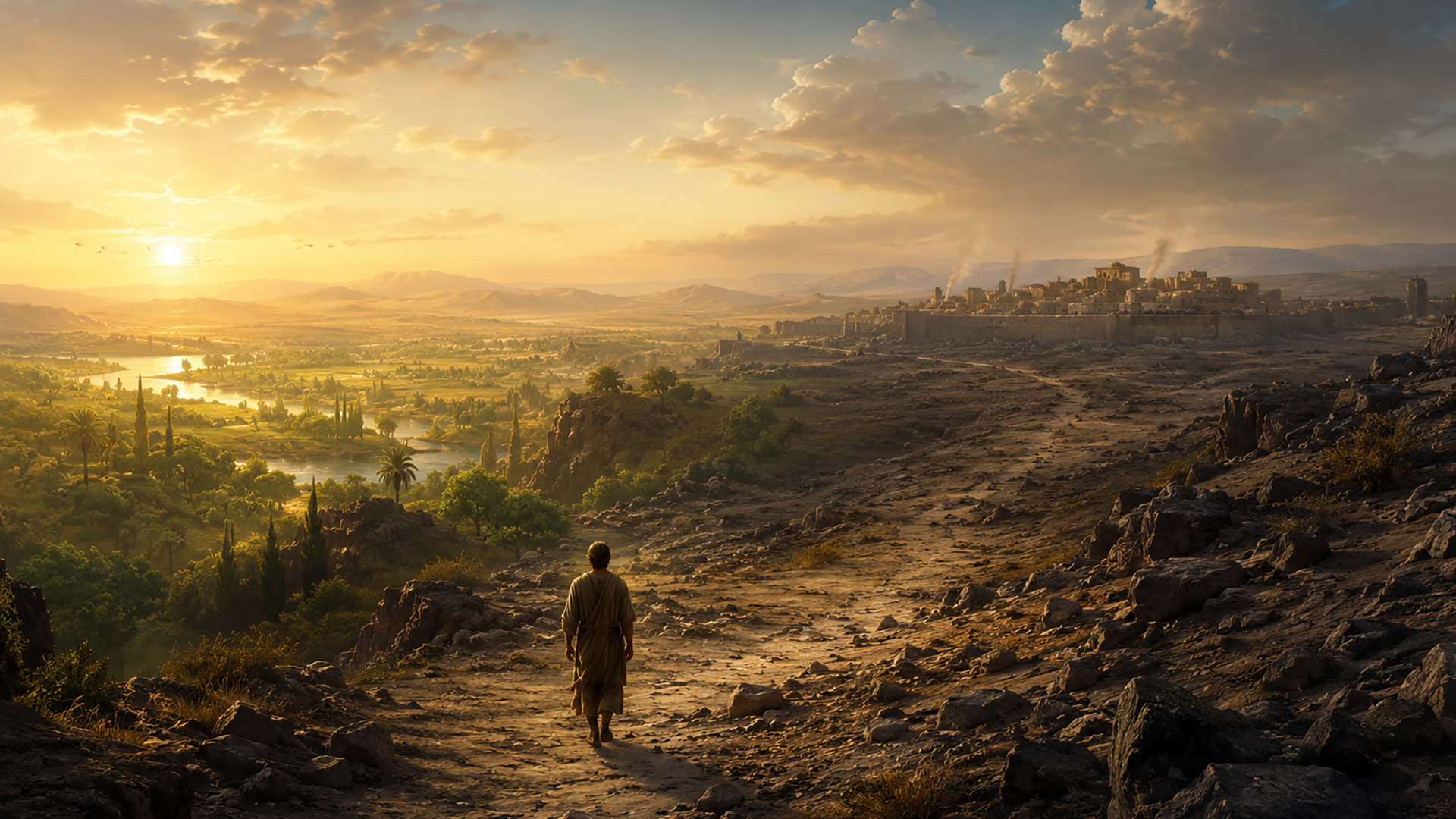
The image in our minds is a figure walking east with the garden behind him. It is a picture of chosen distance. And it is one of the saddest images in Scripture.
A Civilization Built Apart From God
What follows Cain’s departure is one of the most culturally provocative passages in Genesis, and one of the least discussed.
Cain builds a city. His descendants develop livestock management, music and metalworking. Civilization advances. Culture advances. Technology advances. Taken at face value, this looks like progress, and in one sense it is. Human creativity and ingenuity, even when exercised far from God’s presence, still reflect the image of God in which humanity was made.
But another pattern is unfolding alongside the achievement. As the civilization grows more sophisticated, it grows more violent. By the time we reach Lamech, just a few generations from Cain, we encounter a man boasting to his wives about killing another human being and daring anyone to come after him for it. The tone has shifted from Cain’s fearful evasion of responsibility to Lamech’s proud embrace of it.
This is what popular culture consistently gets wrong about human progress. The assumption that advancement in knowledge, technology and cultural sophistication naturally produces better, more peaceful and more just societies is not supported by Genesis, and it is not supported by history. A civilization can grow more impressive while simultaneously growing more dangerous. Human achievement divorced from God does not trend upward toward righteousness. It trends toward Lamech.
Genesis is not pessimistic about human creativity. It is honest about human nature. And the honesty is a mercy, because it points us toward what we actually need.
Two Paths
The chapter does not end with Lamech. It ends with a birth and a decision.
Adam and Eve have another son, Seth. And then Genesis tells us something quietly extraordinary: “At that time people began to call on the name of the Lord.” (Genesis 4:26)
Two lines emerge from the wreckage of Genesis 4. One line builds cities and develops culture and grows in pride and violence while moving further from God’s presence. The other line turns back toward God and calls on His name. That choice, placed at the very end of the chapter, is not incidental. It is the whole point.
The story of Cain is not ultimately about a mark on a murderer. It is about the fork in the road that every human being faces. Every generation, every family, every individual stands somewhere in relation to God’s presence. The question Genesis 4 leaves with the reader is not “what was the mark?” It is “which direction are you walking?”
The Better Brother
The story of Cain and Abel ultimately points beyond itself.
Abel was innocent. Abel’s blood cried out from the ground and God heard it. The New Testament picks up that image and does something extraordinary with it. Hebrews tells us that Jesus’ blood speaks a better word than the blood of Abel. Abel’s blood cried out for justice. Christ’s blood provides forgiveness. Cain took life. Christ gives it.
The man walking east, away from God’s presence, marked and wandering, is the image of every human being who has chosen distance over return. And the God who marked Cain to preserve him rather than destroy him is a picture, incomplete but real, of the God who would one day go much further still to preserve what He had made.
God is not merely revealing information. He is revealing Himself.
The God Who Warns
What does the story of Cain reveal about God?
It reveals a God who warns before judging, who seeks before condemning and who remains just while extending mercy even to those who have done the worst. The invitation God extended to Cain before the murder, the question He asked after it, the mark He placed on him before he wandered away: each of these is an act of a God whose patience outlasts our rebellion and whose mercy pursues us further than we deserve.
The mark on Cain is not the enduring image of Genesis 4. The enduring image is a God who put it there.
Because of the Lord’s great love we are not consumed, for his compassions never fail. They are new every morning; great is your faithfulness. (Lamentations 3:22-23)
The more carefully we read Scripture, the more we discover that familiar passages contain treasures hiding in plain sight. Sometimes the greatest treasure is not the answer to a mystery. Sometimes it is discovering what the mystery was pointing to all along. At the center of it is a God whose mercy is older than our sin and greater than our wandering.